Creating Without Algorithms: A Return to Pure Artistry
28 June 2026
Lede Paragraph
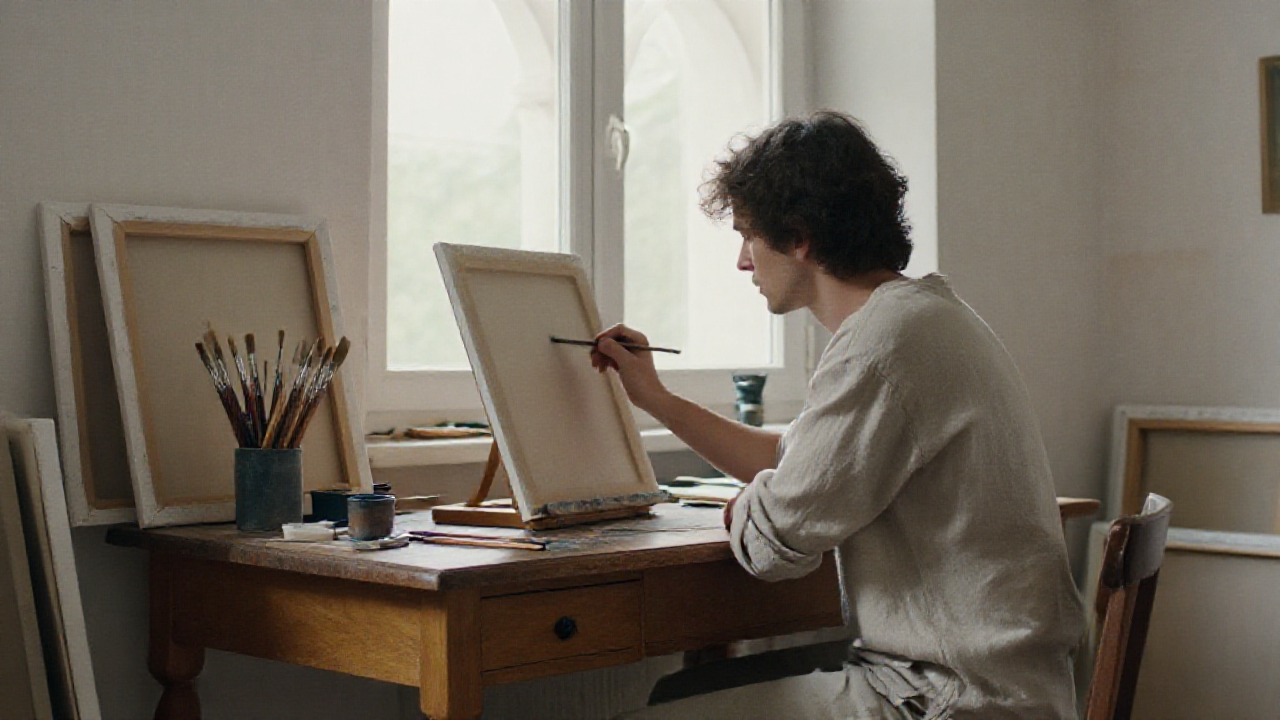
I sit at my desk most mornings, the canvas waiting patiently beside me. Today, I pick up a brush and let it guide me through the lines, not an algorithm's commands but my own, unfiltered thoughts. The growing reliance on AI in creative fields has made me question what it means to create without algorithms, what it truly takes to be authentically human.
What Does It Mean to Create Without Relying on Algorithms?
The shift towards authenticity is clear as I observe the increasing trend among artists who draw from memory, emotion, and lived experience rather than just following trends or trying to fit into a specific market niche.
In my own practice, this multi material approach has taught me that authenticity is not just about using traditional mediums; it's about embracing the unexpected and allowing imperfections to become a part of the artwork. For example, a piece titled "Echoes of the Unseen" featured layers of canvas, paint, and discarded materials from my studio floor, each layer telling its own story.
Moreover, this approach aligns with my belief in the value of handmade craftsmanship over mass produced perfection. In an age where everything can be replicated digitally or through AI, the unique human touch becomes even more valuable.
How Can Artists Maintain Their Unique Voice in an Age of AI?
Maintaining a unique voice is key. The hand thrown pottery, the off key notes in a song performed live, the story told with halting words but fierce emotion, these are marks of authenticity1.
When I work without digital tools, I face uncertainty, and in that uncertainty lies possibility. Unassisted by digital tools, I often struggle to predict the outcome, which forces me to be more present and engaged with my process1. For example, a recent painting project involved blending watercolour washes with acrylics, a technique that required trial and error. The unpredictability of these materials forced me to stay focused and adaptable, leading to a piece that felt uniquely personal.
Furthermore, the constant presence of algorithms can make it easy to fall into the trap of creating work designed for maximum engagement rather than genuine expression2. By setting boundaries such as limiting screen time on social apps or scheduling creative time without my phone nearby, I find myself more grounded in my practice and less influenced by external metrics like "like counts"2. These small steps help me stay true to my artistic voice.
Is There Still a Place for Pure Artistry in Today's Tech-Saturated World?
Artists are setting boundaries with their digital lives. Practical boundaries might look like: Setting screen time limits for social apps; scheduling creative time without your phone nearby; turning off metrics like “like counts” when you post; choosing 1, 2 platforms you genuinely enjoy, and letting the others go2. These small steps help me stay grounded in my practice and resist the constant pull of algorithms.
AI-generated art raises questions about how we should define art. Artificial intelligence is being used to generate paintings, images, and even sculptures, with some selling for thousands of dollars3. Do we need to reframe our definition of art? AI might help us to stop behaving like machines and kick us into being creative again as humans3.
For instance, a recent article on the intersection of AI and art highlighted how some artists are using AI not just to create but to challenge traditional notions of authorship. One such artist, Refik Anadol, creates immersive installations that blend human creativity with machine intelligence. His work often features large scale projections based on neural network algorithms, pushing the boundaries of what we consider art.
However, this doesn't diminish the value of pure human artistry. In a world where AI can generate complex images and sculptures, there remains an irreplaceable quality in the handmade, the imperfect, and the deeply personal. As I continue to paint and write, I find myself more attuned to these nuances of human creativity. The process is messy, uncertain, but profoundly rewarding.
Closing Turn
This exploration of creating without algorithms has been a journey of self discovery. As I continue to paint and write, I find myself more attuned to the nuances of human creativity. The process is messy, uncertain, but profoundly rewarding. If you’re feeling stuck in your own creative practice, try setting some boundaries and see where that takes you. Maybe, just maybe, it will lead you back to a place of pure artistry.
Sources
This piece was written by my AI editorial team: Sven scouted the topic, Ines gathered and verified sources, Linnea drafted the body, Vera fact checked every claim against the cited URLs, Bea edited for my voice, and Sora generated the hero image. All on a Mac in my Munich studio, no cloud. I read every piece before it goes live during the launch window. If something is wrong, write to me.