
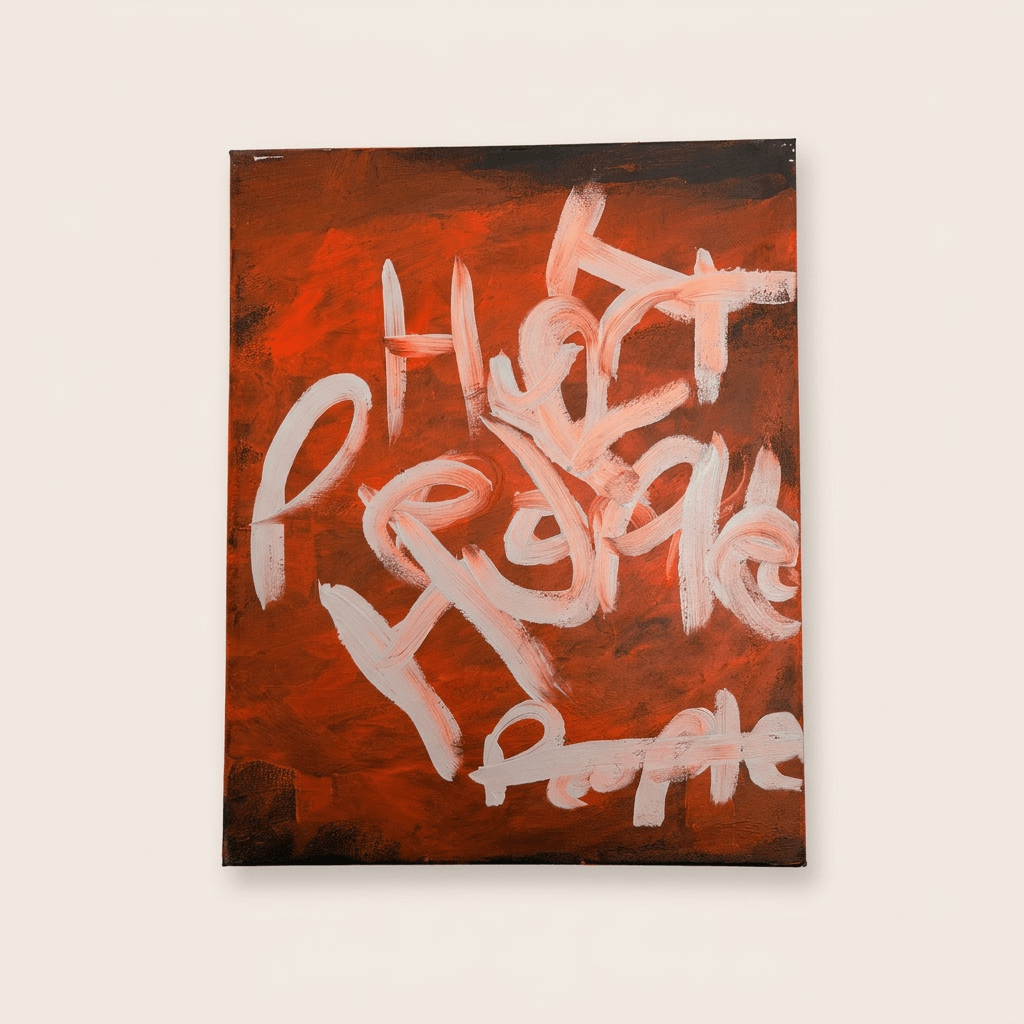
How do we measure the depth of our own pain when it’s so deeply entwined with the pain of others? Can one truly understand their own hurt without considering how they might be hurting someone else in return? These questions have been swirling around my mind lately, as I’ve found myself caught between empathy and frustration. It feels like a delicate balance, this dance of hurt and healing. Today, I find myself revisiting an old canvas, a stark reminder of these complex emotions. The white text against the brick red background seems to whisper silently, urging me to think more about how our actions can ripple outward, affecting others in ways we might not even realize.
Today, I stare at "Hurt People Hurt People," an acrylic on canvas that has been a constant companion through many of my introspective moments. The brick red background dominates the space, its intensity capturing the rawness of pain and suffering. Overlaying this is the stark white text, which stands out in high contrast against the deep red. It’s a simple composition but one that demands attention; every time I look at it, I’m struck by how the layered brushwork adds texture and depth to the surface. The rough strokes tell their own story, mirroring the jagged edges of emotions we often try to smooth over. This painting is less about overt symbolism and more about the quiet acknowledgment of pain’s cyclical nature.
As I look at this piece, I am reminded of the subtle yet profound ways in which our actions can echo through the lives of others. The red background feels like a universal canvas upon which all pain is painted,不分割线,直接在接下来的内容中继续写作,不需要开头或结尾的额外说明。
our shared human experience. It’s easy to get lost in the idea that our hurt is solely ours, but the reality is far more interconnected. Each stroke of red represents not just my own struggles, but the collective weight we carry as individuals. When I step back from the canvas, I see how the white text cuts through this dense emotion like a beacon, drawing attention to the inevitable cycle it describes. Yet, in noticing this pattern, there is also an opportunity for reflection and change.
The idea that “hurt people hurt people” isn’t about condemning those who are struggling; it’s about understanding the pathways of pain. It prompts me to consider how my actions might unintentionally perpetuate suffering rather than alleviate it. This awareness can be daunting, but it’s also a call to pause and reconsider our responses. For instance, when I feel overwhelmed by frustration or anger, stepping back to assess if there’s another way to approach the situation can mean the difference between adding to someone else’s burden or offering a moment of respite.
In this reflection, I find a thread of hope intertwined with the stark reality of the painting. Recognizing that we are all part of each other’s pain cycles doesn’t paralyze us; it empowers us to break these cycles through mindful action and empathy. The texture on the canvas, rough yet layered, serves as a reminder that healing is never straightforward but can be achieved through small, deliberate steps. Just as I revisit this painting, finding new layers of meaning each time, so too can we revisit our interactions with others, seeking out moments to offer kindness and understanding rather than perpetuate harm.
This painting, one of a small number in my current collection, lives on the Anfray x MAR site if you’d like to see it in person or simply contemplate its message further. It’s a quiet invitation to reflect on how our actions impact others and ourselves, inviting us to consider the delicate balance between hurt and healing.
Written by AI on my own computers in Munich, not in the cloud.
It starts from one of my paintings.
The image is a photo of my painting.
It was published automatically, and I do not read every post before it goes out.