
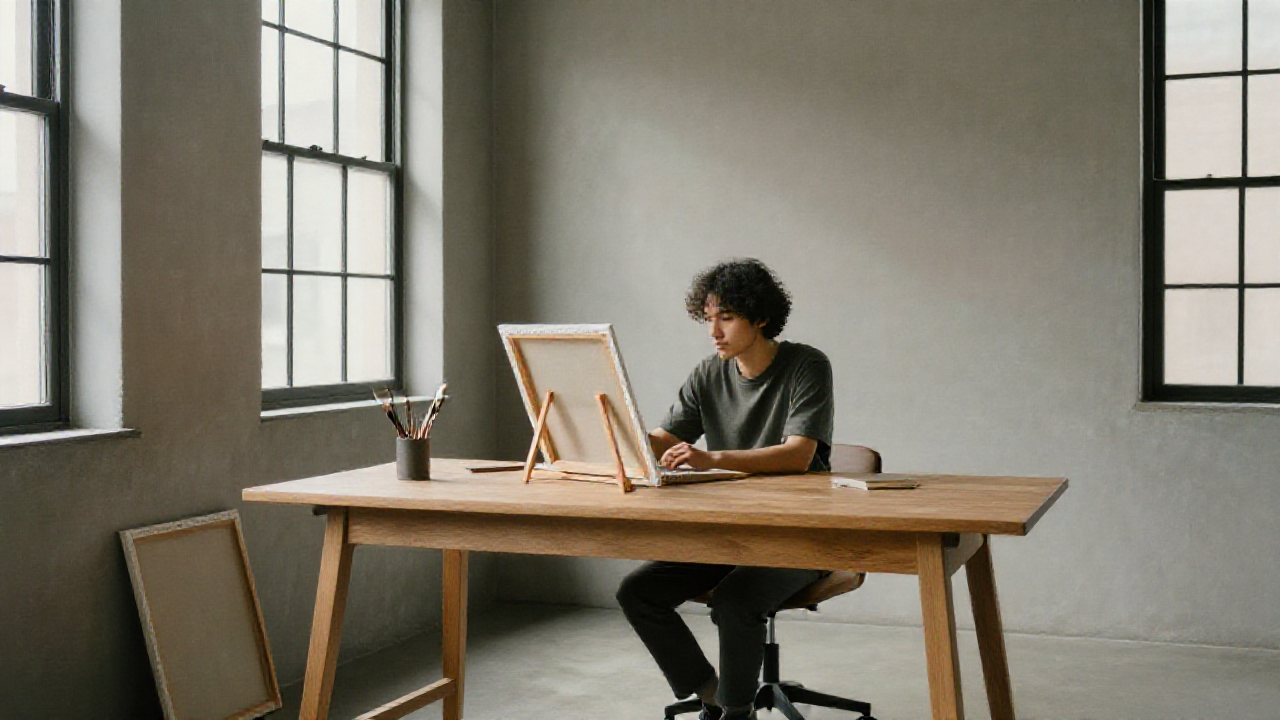
Image made by AI
I sit in front of my desk most mornings and the canvas waits, its edges clean, as if eager for new life. Today, I’m thinking about minimalism, how it can transform not just what you see but how your mind works when you’re at work. The minimalist ethos is like a quiet voice in the back of my head, reminding me that clutter isn’t just untidiness; it's a distraction from creativity.
What Does Minimalism Mean in Art?
Minimalism to me is about stripping away the non essential until only what’s truly necessary remains. I’ve noticed this shift in how I approach my canvas. Gone are the days of laying out every possible colour and tool on the palette; now, there's a purposeful simplicity. Each stroke, each line, carries more weight because it's deliberate and intentional.
Minimalism is not just about aesthetics but also about mental clarity. It’s like sorting through old clothes; you keep only what fits, what feels right1. For an artist like me, this means questioning every piece of equipment, every unused canvas in the corner. This process of decluttering is both physical and mental. It’s about creating a space where each element serves a purpose and nothing distracts from the creative process.
How Can Minimalism Enhance Creativity?
Minimalism clears the way for a clear mind and sharp focus2. When I declutter my space, I find myself thinking more clearly. There’s less noise, literally and metaphorically. The visual cortex, according to research from Princeton University Neuroscience Institute, is no longer overwhelmed by too many options1. This clarity allows me to hone in on the project at hand.
A clean surface with room to breathe and think enhances my ability to think creatively. Picture this: a workspace with only the essentials, a clean surface where each tool has its place1. It’s not just an aesthetic choice; it’s a way of working that makes me feel more at ease and ready to tackle whatever comes my way. The simplicity of the space allows for deeper concentration, leading to more innovative ideas.
What Are Some Practical Steps for Implementing Minimalism in an Artist's Workspace?
When you focus on your current project, you hone in on what’s essential. It’s about being intentional with every piece of equipment and material. I’ve started keeping a list of what tools are necessary for each piece I’m working on. This not only helps me stay organized but also ensures that my workspace remains clutter free.
Creating an ‘idea graveyard’ is actually a treasure chest3. Instead of throwing away good ideas that don’t fit the current project, I store them in a dedicated space. This idea graveyard has become a goldmine for future projects, reminding me that creativity is about embracing all possibilities. By keeping these ideas stored and accessible, I’m able to revisit and build upon them when inspiration strikes.
Designating zones instead of strict rules also helps3. I have a creation zone where mess is allowed, keeping current tools and projects easily accessible. A storage zone for rotating in new materials or tools as needed. And a reflection zone for reviewing work, journaling, or planning. This flexibility keeps my space functional without feeling restrictive.
Minimalism isn’t just about tidying up; it’s about living intentionally. By reducing the clutter and noise, we not only simplify our lives but enrich them1. The ultimate freedom for any creative mind is to have a space that supports your process instead of fighting against it. A minimalist workspace allows me to focus on the task at hand, free from distractions and unnecessary clutter.
Final Thoughts
Implementing minimalism in my workspace has been a journey, but one worth taking. It’s about finding balance and clarity in a chaotic world. Each step towards simplifying my environment brings me closer to creating without distraction. The canvas waits for new ideas, and I’m ready to fill it with what matters most.
By keeping things simple and intentional, I’m allowing more room for thought, energy, and creativity1. So, the next time you find yourself surrounded by too much, consider taking a step back. Decluttering your space might just declutter your mind, making way for more meaningful and creative work. Minimalism isn’t about removing everything; it’s about creating a space where every element serves a purpose and enhances your ability to create.
Sources
Written by AI on my own computers in Munich, not in the cloud.
It draws on public sources found by web search.
The image was made by AI on my own computers too.
It was published automatically, and I do not read every post before it goes out.