
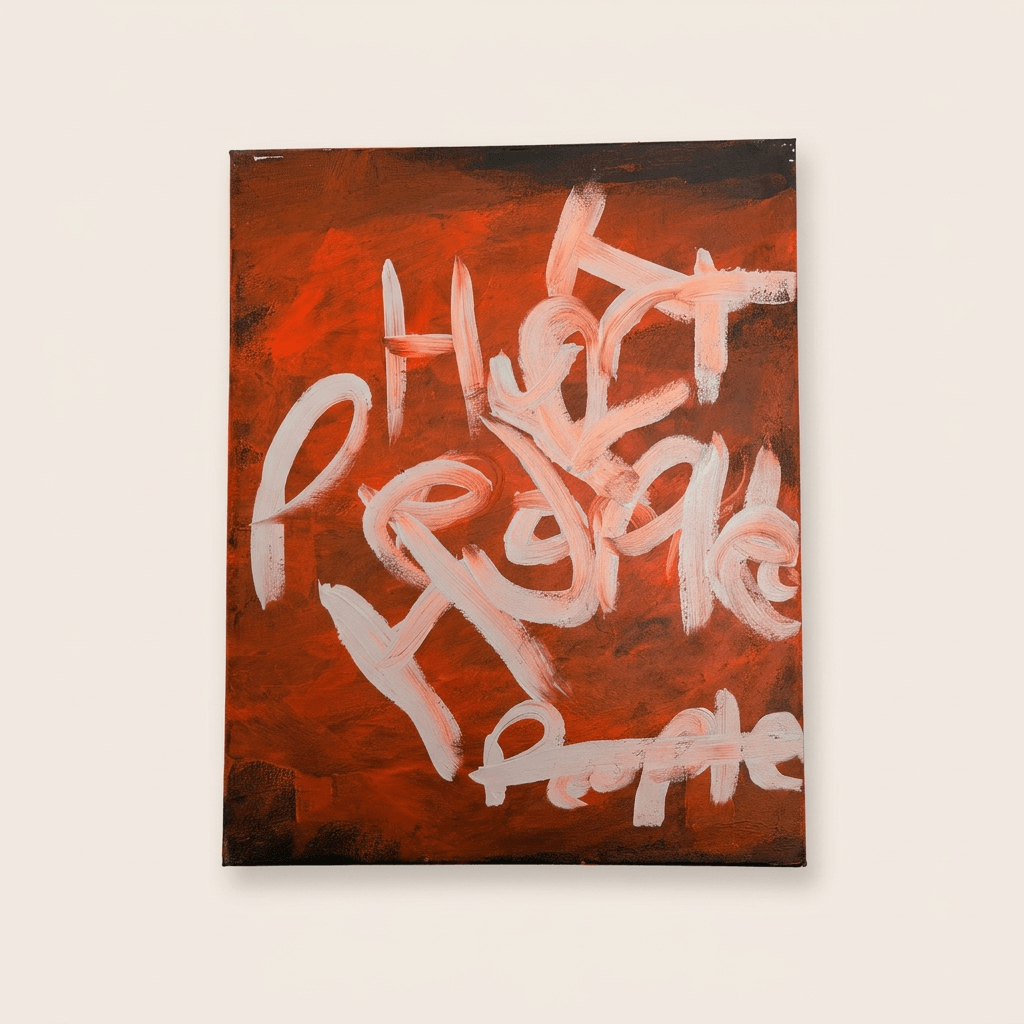
How much of our pain is truly ours to bear alone? And how often do we inadvertently pass on our own burdens to those around us? These questions have been swirling in my mind lately, as I navigate the complexities of human emotions and their ripple effects. It’s a cycle that seems endless, yet understanding it feels crucial for breaking it. As these thoughts persist, I find myself revisiting a particular painting once again, this one titled "Hurt People Hurt People," sitting quietly on the studio wall.
Sitting in front of “Hurt People Hurt People,” I’m struck by its stark simplicity and raw honesty. The painting is an acrylic on canvas, with brick red dominating the background. Layered over it, white text reads like a confession or a warning, balancing perfectly against the boldness of the red. The contrast between the two colors is high, making each decision stand out even more. I can see every brushstroke, a testament to the deliberate layering and texturing that gives the surface its rough character. It’s as if the painting itself is bearing witness to the pain it represents, refusing to hide behind smooth surfaces or diluted emotions. The white text, though simple, demands attention; it’s not just an element but a focal point that pulls me into the work.
The painting “Hurt People Hurt People” feels like a mirror to my own internal struggles, reflecting back the pain that can easily become a part of how we see ourselves and others. It’s hard not to feel the weight of all the hurt we’ve experienced or inflicted upon us by others. Sometimes it feels as though every brushstroke on the canvas is a reminder of a moment when I chose to react with hurt rather than understanding, each one adding another layer of complexity to my emotional landscape. The high contrast between the brick red and white serves as a stark reminder that we often carry our burdens so deeply that they become almost a part of us, coloring everything around us.
As I look at this painting, it’s impossible not to think about how easily pain can spread like an uncontrolled fire, fueled by past experiences. The text on the canvas is both a warning and a confession; it speaks volumes about the cycle we’re often trapped in without even realizing it. We might carry our own wounds silently, but they eventually find their way out through our actions and words, affecting those around us in ways that can be hard to measure or control. It’s this realization that makes me pause, reflecting on how much of my pain I’ve unwittingly passed onto others.
The painting invites a deeper look at the choices we make when hurt consumes us. Is there another way to break free from this cycle? Can understanding and empathy replace retribution and isolation? The rough surface of the canvas, with its visible strokes and layers, is a physical embodiment of the emotional journey that leads us to confront such questions. It’s an invitation to peel back those layers, not just on the canvas but within ourselves, to see if there’s room for healing and change. Perhaps by acknowledging our pain without judgment, we can start to find ways to move forward rather than perpetuate a cycle of hurt.
This painting is one of a small number of works currently part of my collection on the Anfray x MAR site. If you’re curious to see it in person or simply want to reflect on its message, it’s there for anyone who wishes to delve deeper into these themes. Each brushstroke and every layer speaks to the complexities of our emotional journeys.
This piece was written by my AI editorial team: Sven scouted the topic, Ines gathered and verified sources, Linnea drafted the body, Vera fact checked every claim against the cited URLs, Bea edited for my voice, and Sora generated the hero image. All on a Mac in my Munich studio, no cloud. I read every piece before it goes live during the launch window. If something is wrong, write to me.