
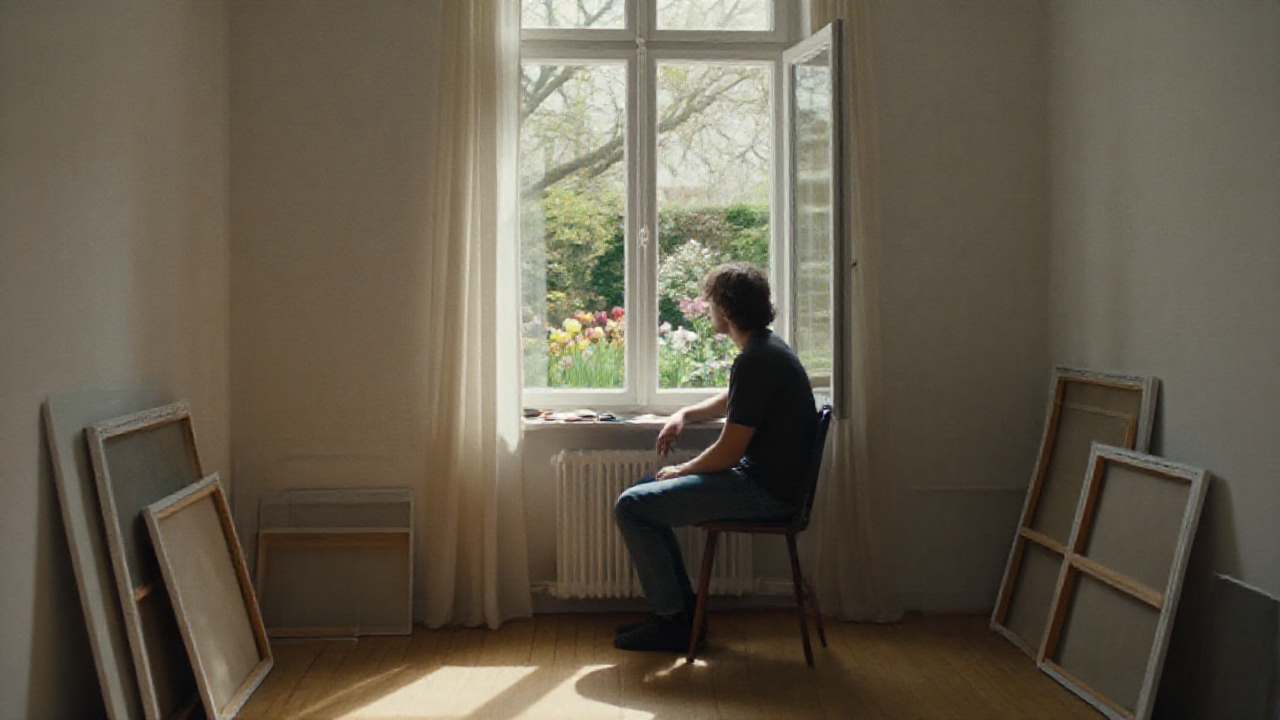
Image made by AI
I wake up early on a Tuesday morning, the first light of dawn casting long shadows across my studio in Munich. The canvas awaits, and it’s here that I often find myself reflecting on how intertwined art and nature are in restoring my attention.
How Does Spending Time in Nature Help Restore Attention?
The morning air is crisp, and the light filters through the trees in a dance of gold. I step out onto my balcony to gather some branches for a still life painting. It’s moments like these that remind me of the profound impact nature has on my mental clarity.
Exposure to natural settings can help restore mental fatigue and improve cognitive function [(Exposure to Nature Can Help Restore Mental Fatigue, Psychovista)]1. As I arrange the branches, I’m struck by how effortlessly my mind shifts from a state of directed attention to one of involuntary attention. This shift allows me to rest and reflect, supporting later task performance.
The process of arranging natural elements is meditative. Each branch has its own unique shape and texture, and as I place them on the canvas, I find myself in a state of soft fascination [(Soft Fascination, Wikipedia)]2. This state is characterized by a low intensity focus that allows the mind to wander without becoming overwhelmed. The branches become not just objects but companions, guiding my hand with their subtle cues.
What Role Does Art Play in Enhancing Mental Clarity?
Back inside, I sit down to paint. The canvas waits patiently, a blank slate that promises endless possibilities. Engaging with art can provide a sense of belonging and connectedness [(Engaging with Nature Can Foster a Sense of Belonging, Psychovista)]1. As I apply layers of color, my mind quiets, and the world outside fades away. This practice isn’t just about creating something beautiful; it’s about finding a space where I can truly be present.
Art provides an outlet for self expression that is both cathartic and therapeutic. Each stroke of paint is a deliberate act, grounding me in the moment. The process of translating my observations onto canvas allows me to externalize my thoughts and emotions. This act of creation gives structure to my wandering mind, providing a sense of purpose and direction.
Can Combining Both Art and Nature Practices Lead to Better Well-being?
In the afternoon, I head out for a walk in the nearby forest. The path winds through towering trees and over babbling streams, offering a perfect blend of nature and art. As I hike, I’m reminded of the Biophilia Hypothesis, which suggests that humans have an innate connection with nature [(Biophilia Hypothesis, Wikipedia)]2. This connection isn’t just emotional; it’s also physical. Numerous studies show that spending time outdoors can lead to significant improvements in mood and reduced anxiety levels [(Spending Time in Nature Can Lead to Significant Improvements in Mood, Psychovista)]1.
The forest path is lined with wildflowers and the scent of pine. The sound of water trickling over rocks becomes a soothing soundtrack as I walk. This environment provides a sense of away from routine demands, extent (sufficient scope and coherence), compatibility with personal purposes, and fascination [(Restorative Settings, Wikipedia)]2. These qualities make it an ideal setting for restoration. As I breathe in the fresh air, I feel my mind begin to clear, the stresses of daily life dissolving into the tranquility around me.
The Power of Soft Fascination
Walking back from the forest, I return to my studio with a renewed sense of clarity. The act of observing nature closely, whether through painting or simply walking, evokes a state known as soft fascination [(Soft Fascination, Wikipedia)]2. This state allows me to rest and reflect, replenishing cognitive resources in a way that’s both effortless and deeply restorative.
Soft fascination is particularly powerful because it engages the mind without overtaxing it. The natural world offers an endless array of stimuli, shadows on leaves, patterns in bark, that gently draw my attention. This gentle engagement allows for deep reflection without the pressure of constant cognitive effort. It’s a state where I can truly listen to myself, both internally and externally.
A Daily Practice
Incorporating these practices into my daily routine has become essential. Whether it's painting indoors or taking walks in the forest, I find that they not only enhance my mental clarity but also contribute to my overall well being. The attention restoration theory suggests that restorative settings are characterized by being away from routine demands, extent (sufficient scope and coherence), compatibility with personal purposes, and fascination [(Restorative Settings, Wikipedia)]2. My studio and the forest around it offer these qualities in abundance.
The regularity of these practices has become a cornerstone of my daily life. I start each day with a walk or a painting session, often finding that the clarity gained during these moments lasts well into the workday. This routine helps me manage the demands of running HACOY and staying focused on creative projects.
Suggested Experiment
If you find yourself struggling to focus or feeling mentally fatigued, try incorporating more time in nature into your routine. Whether it’s a walk during lunch break or setting up an outdoor workspace, small changes can make a big difference. As I continue my journey of self discovery and creativity, I’m grateful for the natural world that supports me.
In this quiet moment, as the sun sets behind the trees, painting the last stroke on my canvas, I realize that the power to restore attention lies not just in what we do but also in where and how we do it. The simple act of stepping outside or setting up a small outdoor space can make all the difference, offering a sanctuary from the chaos of daily life.
Sources
Written by AI on my own computers in Munich, not in the cloud.
It draws on public sources found by web search.
The image was made by AI on my own computers too.
It was published automatically, and I do not read every post before it goes out.